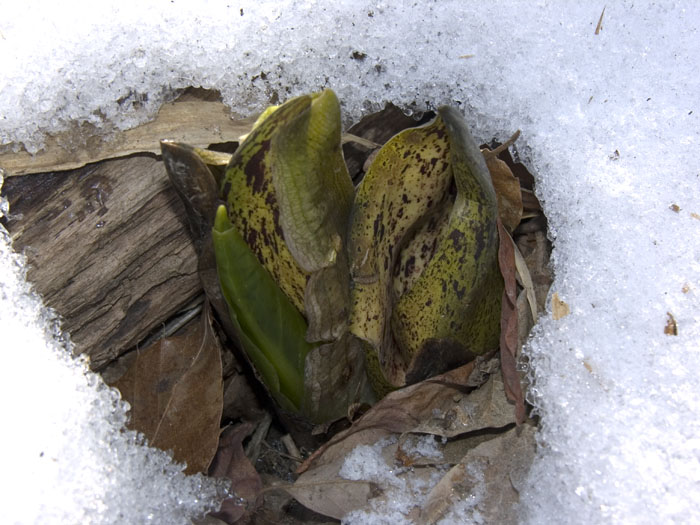
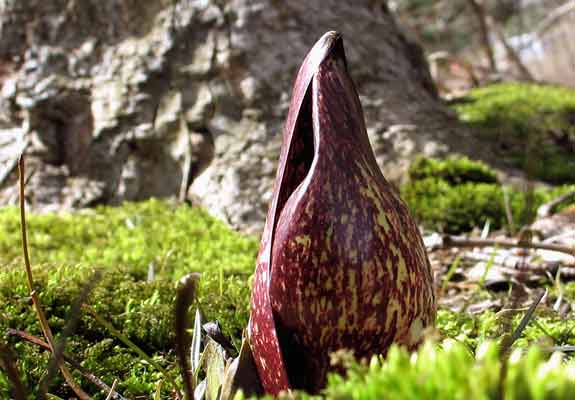
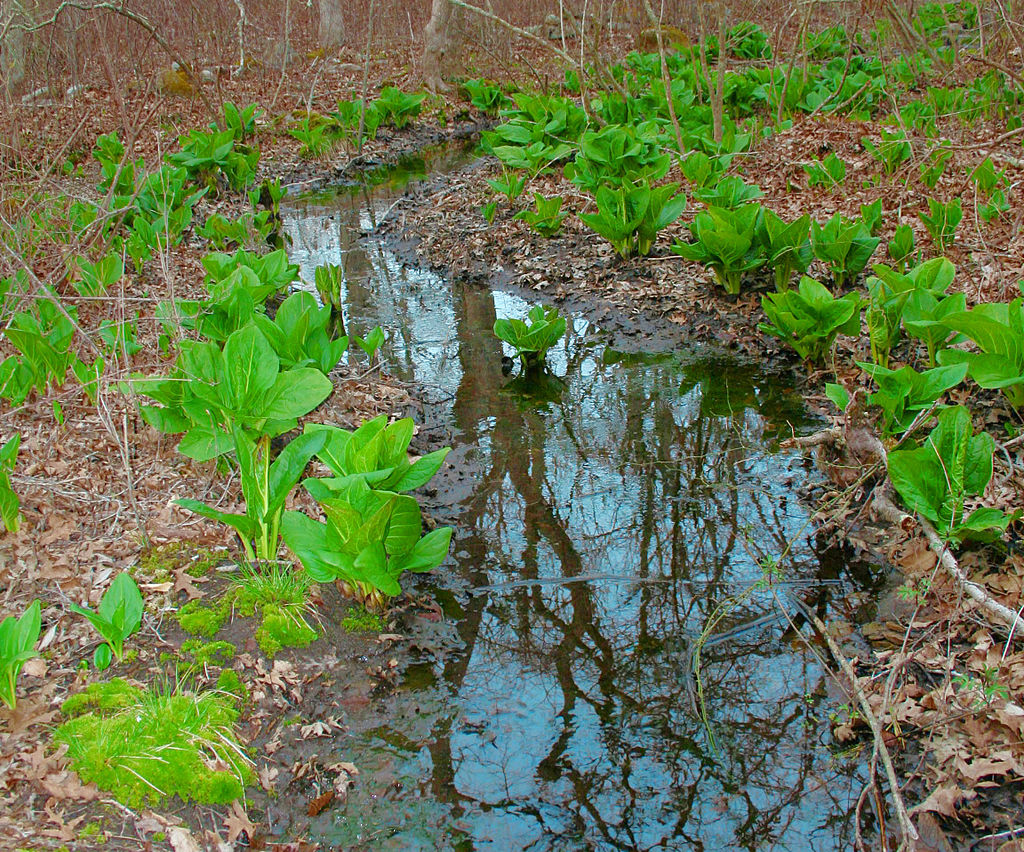
Eastern Skunk Cabbage is the first plant to poke its head through the ground in the swamps of New England, budding just before bears come out of their dens. It melts the ice and snow around it by generating heat through a chemical process remarkably similar to that used by hibernating animals to raise their temperature as they rouse from sleep. Depending on how many acorns are left on the ground, Eastern Skunk Cabbage will make up somewhere between fifty percent and ninety-nine percent of a Black Bear’s diet in New England in early spring.
Skunk Cabbage is perhaps best known as a respiratory medicine. The 1898 edition of the American Dispensatory describes Eastern Skunk Cabbage root as “a stimulant, exerting expectorant.” Just as the plant’s contractile roots reach deep into swampy soils to drink up moisture, the root as a medicine brings up excess mucous from deep in the lungs. It is one of only two medicines that I have seen bring relief to people experiencing the terrifying and so far unexplained bouts of “air hunger” associated with chronic Lyme disease and chronic COVID-19 infection. (The other medicine that helps here is its cousin, Wester Skunk Cabbage, Lysichiton americanus, which Stephen Harrod Buhner first recommended for this symptom.)
It has other ways of addressing what we hold deep below as well. Eastern Skunk Cabbage contains 5-hydroxytryptamine, identical to one of our own neurotransmitters—serotonin, which is responsible for opening sensory gating channels and encouraging synaptic branching in human nervous systems.
At low doses, the tincture of the root induces a deep sense of stillness and calm, like the waters of a vernal pool. William Cook described it as “a simple and reliable nervine, of the most innocent and effective soothing character” (1869b). At higher doses, the tincture begins to have an entheogenic effect. The world becomes more fluid. Distinctions between thought and emotion dissolve.
Tryptamines work to reorder the ways in which we process the information we get from the world. As entheogens, both Eastern Skunk Cabbage and Western Skunk Cabbage seem to work with the integration of the rational consciousness of the brain and the emotional and transpersonal consciousness of the heart. (It’s not clear whether Western Skunk Cabbage contains tryptamines, but Stephen Harrod Buhner first observed this phenomenon with a snuff made from Western Skunk Cabbage roots, and I’ve observed similar effects with the tincture.)
Eastern Skunk Cabbage has a strong affinity with the lungs (contemporary and traditional use as a stimulating expectorant), the heart (it is used for a “weak heart” among the Menominee People of the land now called Wisconsin according to a friend who is part of that culture), and the waters that flow through our bodies (affinity for the kidneys and uterus). Thus, at commonly used medicinal doses, Eastern Skunk Cabbage will help to clear the physical manifestations of grief that gets buried in the lungs.
At large doses in the proper extraction, it begins to address such grief at a soul level through reconnection to the dreaming mind of the earth—especially when potentiated by an MAO- A inhibitor such as Syrian Rue (Peganum harmala). (Note that MAO-A inhibitors can be dangerous for those with hypertension and those on psychiatric medications.) In the process, it carries a person through the grief of many lifetimes—a harrowing journey, to say the least. Like psilocybin, the serotonin in Skunk Cabbage and the harmaline in Syrian Rue are best extracted in a gently acidic menstruum, like vinegar.
In both cases, the healing work is not to be undertaken lightly—the pain released needs a container, and the journey back to the self is a journey through a world fraught with its own perils and challenges. Ecstatic methods require focus to avoid becoming purely chaotic and unleashing unintended consequences.
Eastern Skunk Cabbage can be a vehicle for traveling beneath the surface of the waters of consciousness, to encounter the source of the wound, and move through it and past it, undoing its power to shape consciousness and define identity. The perils lie in the potential of becoming so immersed in the pain and grief that the journey is never completed. But when the journey is completed, the wound is transformed from a source of pain to an opening between worlds that initiates the traveler into the compassion that comes from understanding grief and into the wellspring of healing. This wellspring lies beneath the surface; it comes from the heart of the universe and rises from the center of our heart to flow outward, blessing and transforming all worlds. Eastern Skunk Cabbage can offer an opening to the realms where such transformation is possible.
This Bear medicine stirs the sleeping Animal Self, awakening us into fuller presence.
Safety considerations: The calcium oxalate crystals in the root can be irritating to both the airways and the digestive tract. A long drying period will reduce their concentration, and they will not extract in a tincturing process. They can be released into the air by chopping the root, so only process the roots in a well-ventilated area while wearing a mask or respirator.
Ecological considerations: While locally abundant in many places, this plant cannot be cultivated, and individual plants can be over a thousand years old, so be very sparing with your harvest. The root of one plant, dug in winter when the plant is first melting through the ice will produce enough tincture to serve one herbalist for many seasons – and the process of digging and pulling in water and mud just one or two degrees above freezing is quite the initiation into deep relation with this plant. For most it will be better to make a flower essence – wait until the plant is flowering, and during a new moon or a full moon place a bowl of water at its base overnight. Gather the water the next morning and mix with an equal part whiskey or poteen or moonshine to preserve it.”

“Last year alone, over 400 voter suppression bills, specifically targeted Black and Brown voters, were introduced in states nationwide.
That’s why today, the House has passed the Freedom to Vote: John R. Lewis Act, a combination of the Freedom to Vote Act and the John R. Lewis Voting Rights Advancement Act.
In addition to creating federal standards for voting access, the bill would make Election Day a holiday, establish same-day voter registration, and require an early voting period in all states.
With the House passing this historic voting rights legislation today, The Senate now has a choice: They can stand by the filibuster, which has consistently been used to stop Civil Rights legislation from passing, or they can support the right to vote and fight back.”